%20%20--%3E%0A%3Csvg%20version%3D%221.1%22%20xmlns%3D%22http%3A%2F%2Fwww.w3.org%2F2000%2Fsvg%22%20xmlns%3Axlink%3D%22http%3A%2F%2Fwww.w3.org%2F1999%2Fxlink%22%20x%3D%220px%22%20y%3D%220px%22%0A%09%20viewBox%3D%220%200%202634%20200%22%20style%3D%22enable-background%3Anew%200%200%202634%20200%3B%22%20xml%3Aspace%3D%22preserve%22%3E%0A%3Cstyle%20type%3D%22text%2Fcss%22%3E%0A%09.st0%7Bfill%3A%23231F20%3B%7D%0A%09.st1%7Bfill%3A%23004A8D%3B%7D%0A%09.st2%7Bfill%3A%237BB2DE%3B%7D%0A%09.st3%7Bfill%3A%23FFFFFF%3B%7D%0A%09.st4%7Bfill%3A%23634F2E%3B%7D%0A%09.st5%7Bopacity%3A0.5%3Bfill%3A%23634F2E%3B%7D%0A%09.st6%7Bopacity%3A0.35%3B%7D%0A%09.st7%7Bfill%3A%23B08C5A%3B%7D%0A%3C%2Fstyle%3E%0A%3Cg%20id%3D%22Template%22%3E%0A%3C%2Fg%3E%0A%3Cg%20id%3D%22Layer_2%22%3E%0A%09%3Cg%3E%0A%09%09%3Cpolygon%20class%3D%22st3%22%20points%3D%22169.1%2C0%20110.6%2C0%2052.6%2C91.1%2052.6%2C0%200%2C0%200%2C200%2052.6%2C200%2052.6%2C161.7%2081.4%2C121.7%20115.4%2C200%20172%2C200%20%0A%09%09%09114.3%2C76.3%20%09%09%22%2F%3E%0A%09%09%3Crect%20x%3D%22190.6%22%20class%3D%22st3%22%20width%3D%2253.7%22%20height%3D%22200%22%2F%3E%0A%09%09%3Cpolygon%20class%3D%22st3%22%20points%3D%22398%2C106.3%20332.5%2C0%20279.1%2C0%20279.1%2C200%20331.1%2C200%20331.1%2C85.4%20402.3%2C200%20450%2C200%20450%2C0%20398%2C0%20%09%09%22%2F%3E%0A%09%09%3Cpath%20class%3D%22st3%22%20d%3D%22M600%2C0h-78.9c-26.3%2C0-38.9%2C12.6-38.9%2C38.9v122.3c0%2C26.3%2C12.6%2C38.9%2C38.9%2C38.9H600c26.3%2C0%2C38.9-12.6%2C38.9-38.9%0A%09%09%09V83.4h-82.6v42.3h29.4v25.1c0%2C4-1.1%2C5.1-5.1%2C5.1h-39.4c-4%2C0-5.1-1.1-5.1-5.1V49.1c0-4%2C1.1-5.1%2C5.1-5.1h39.4c4%2C0%2C5.1%2C1.1%2C5.1%2C5.1%0A%09%09%09V66h53.1V38.9C638.8%2C12.6%2C626.2%2C0%2C600%2C0z%22%2F%3E%0A%09%09%3Cpath%20class%3D%22st3%22%20d%3D%22M777.1%2C83.1l-53.1-14.3c-5.1-1.4-6-2.3-6-5.4V48c0-4%2C1.1-5.1%2C5.1-5.1h32.9c4%2C0%2C5.1%2C1.1%2C5.1%2C5.1v16.3h53.7%0A%09%09%09V38.9c0-26.3-12.6-38.9-38.9-38.9h-72.9c-26.3%2C0-38.9%2C12.6-38.9%2C38.9v34.9c0%2C28.6%2C13.1%2C33.4%2C41.1%2C41.1l53.1%2C14.6%0A%09%09%09c4.6%2C1.1%2C6%2C2%2C6%2C5.1V152c0%2C4-1.1%2C5.1-5.1%2C5.1h-36.9c-4%2C0-5.1-1.1-5.1-5.1v-18.3h-53.7v27.4c0%2C26.3%2C12.6%2C38.9%2C38.9%2C38.9h76.9%0A%09%09%09c26.3%2C0%2C38.9-12.6%2C38.9-38.9v-36.9C818.2%2C95.7%2C805.1%2C90.6%2C777.1%2C83.1z%22%2F%3E%0A%09%09%3Cpath%20class%3D%22st3%22%20d%3D%22M961.3%2C61.6h-42.9c-17%2C0-26.7%2C8-30.3%2C25L876.2%2C142c-3.6%2C17%2C2.7%2C25%2C19.7%2C25h42.9c17%2C0%2C26.7-8%2C30.3-25%0A%09%09%09l11.8-55.4C984.5%2C69.6%2C978.2%2C61.6%2C961.3%2C61.6z%20M945.6%2C92.8l-9.1%2C42.9c-0.6%2C2.9-1.8%2C3.9-4.7%2C3.9h-17.2c-2.9%2C0-3.7-1-3.1-3.9%0A%09%09%09l9.1-42.9c0.6-2.9%2C1.8-3.9%2C4.7-3.9h17.2C945.5%2C88.9%2C946.3%2C89.9%2C945.6%2C92.8z%22%2F%3E%0A%09%09%3Cpath%20class%3D%22st3%22%20d%3D%22M1014.8%2C49.5l-2.6%2C12.1h-14.8l-5.6%2C26.4h14.8l-16.8%2C79h34.7l16.8-79h20.7l5.6-26.4h-20.7l1.5-7%0A%09%09%09c0.6-2.9%2C1.8-3.9%2C4.7-3.9h14.8l5.6-26.2h-28.5C1028.1%2C24.5%2C1018.4%2C32.5%2C1014.8%2C49.5z%22%2F%3E%0A%09%09%3Cpolygon%20class%3D%22st3%22%20points%3D%221299.4%2C0%201240.8%2C0%201182.8%2C91.1%201182.8%2C0%201130.2%2C0%201130.2%2C200%201182.8%2C200%201182.8%2C161.7%201211.6%2C121.7%20%0A%09%09%091245.6%2C200%201302.2%2C200%201244.5%2C76.3%20%09%09%22%2F%3E%0A%09%09%3Cpath%20class%3D%22st3%22%20d%3D%22M1364.2%2C0l-60.3%2C200h54.9l10.6-41.1h58.9l10.6%2C41.1h57.1L1435.1%2C0H1364.2z%20M1380.2%2C116l18.6-72.3l18.6%2C72.3%0A%09%09%09H1380.2z%22%2F%3E%0A%09%09%3Cpath%20class%3D%22st3%22%20d%3D%22M1610.8%2C148.6c0%2C3.4-1.7%2C5.1-5.1%2C5.1h-37.1c-3.4%2C0-5.1-1.7-5.1-5.1V0h-53.7v161.1c0%2C25.1%2C13.7%2C38.9%2C38.9%2C38.9%0A%09%09%09h77.1c25.1%2C0%2C38.9-13.7%2C38.9-38.9V0h-53.7V148.6z%22%2F%3E%0A%09%09%3Cpolygon%20class%3D%22st3%22%20points%3D%221698.5%2C200%201752.2%2C200%201752.2%2C123.4%201821%2C123.4%201821%2C79.4%201752.2%2C79.4%201752.2%2C44.6%201839%2C44.6%201839%2C0%20%0A%09%09%091698.5%2C0%20%09%09%22%2F%3E%0A%09%09%3Cpolygon%20class%3D%22st3%22%20points%3D%221862.7%2C200%201916.4%2C200%201916.4%2C123.4%201985.3%2C123.4%201985.3%2C79.4%201916.4%2C79.4%201916.4%2C44.6%202003.3%2C44.6%20%0A%09%09%092003.3%2C0%201862.7%2C0%20%09%09%22%2F%3E%0A%09%09%3Cpolygon%20class%3D%22st3%22%20points%3D%222132.4%2C105.1%202087.6%2C0%202027%2C0%202027%2C200%202077.9%2C200%202077.9%2C84.9%202115.3%2C175.7%202147.9%2C175.7%20%0A%09%09%092185.3%2C84.9%202185.3%2C200%202237.3%2C200%202237.3%2C0%202177.3%2C0%20%09%09%22%2F%3E%0A%09%09%3Cpath%20class%3D%22st3%22%20d%3D%22M2315.5%2C0l-60.3%2C200h54.9l10.6-41.1h58.9l10.6%2C41.1h57.1L2386.4%2C0H2315.5z%20M2331.6%2C116l18.6-72.3l18.6%2C72.3%0A%09%09%09H2331.6z%22%2F%3E%0A%09%09%3Cpolygon%20class%3D%22st3%22%20points%3D%222584.1%2C0%202584.1%2C106.3%202518.7%2C0%202465.3%2C0%202465.3%2C200%202517.3%2C200%202517.3%2C85.4%202588.4%2C200%202636.1%2C200%20%0A%09%09%092636.1%2C0%20%09%09%22%2F%3E%0A%09%3C%2Fg%3E%0A%3C%2Fg%3E%0A%3C%2Fsvg%3E%0A)

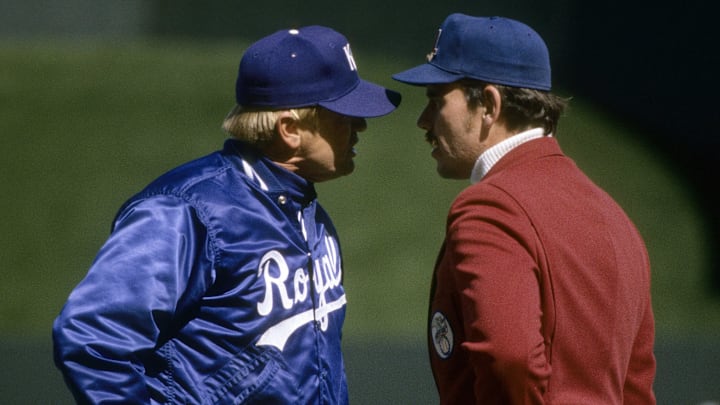
The Kansas City Royals are not exactly a fruitful farm for future Hall of Fame players. Third baseman George Brett remains the lone homegrown Royal in Cooperstown, even though a handful of future Hall of Famers passed through Kansas City late in their careers.
Such is the life of an expansion franchise, while older clubs benefited from the Hall of Fame boom earlier in the 20th century.
But the organization’s connection to Cooperstown goes beyond what happened between the lines. Several Hall of Famers made their mark elsewhere, yet spent meaningful time with the Royals as managers, executives, or scouts.
Here are five Hall of Fame figures with Royals ties, even if their Hall-worthy accomplishments largely came outside Kansas City.
Whitey Herzog (1975–1979)
Widely regarded as one of the era’s best strategists, Whitey Herzog took over as Royals manager midway through 1975 and quickly turned a young franchise into a contender.
In his first full season, Herzog led Kansas City to its first-ever playoff berth, then kept them there with three straight AL West titles in 1976, 1977, and 1978. The 1977 club won 102 games, which still stands as a franchise record, and did it with Herzog’s aggressive, pressure-based “Whiteyball” style.
The Royals fell in the ALCS each of those seasons, each time to the New York Yankees, but Herzog’s .574 winning percentage in Kansas City (410–304) remains the best of any manager in franchise history.
He also wasn’t shy about speaking his mind, and his relationship with ownership grew tense after those near-misses. After a step back in 1979, the Royals moved on. Herzog wasn’t unemployed long: the St. Louis Cardinals hired him in 1980, and he went on to win three pennants and the 1982 World Series, cementing his legacy as a championship manager.
Herzog was inducted into the Baseball Hall of Fame in 2010.
John Schuerholz (1981–1990)
Long before he became the architect of the 1990s Atlanta Braves machine, John Schuerholz helped build the Royals into a champion. He joined Kansas City’s front office at the franchise’s inception in 1969, rising through scouting and player development before becoming general manager in late 1981. At 41, Schuerholz was the youngest general manager in baseball at the time.
Taking over a club that had ruled the late-1970s AL West, Schuerholz navigated a transition to a younger core and, by 1985, had assembled the roster that delivered Kansas City’s first World Series championship. Homegrown stars like Bret Saberhagen and Danny Jackson, paired with franchise cornerstone George Brett, carried the Royals to a seven-game classic over St. Louis.
Schuerholz’s résumé only grew after he left for Atlanta in 1990. He became the first general manager to win a World Series in both the American and National Leagues (1985 Royals, 1995 Braves), then oversaw an extraordinary run of division titles in Georgia.
He was elected to the Hall of Fame in 2017 for his executive accomplishments.
Buck O’Neil (1988–2006)
Buck O’Neil is in the Hall of Fame for his lifetime of contributions to baseball, and so much of that story runs through Kansas City. O’Neil first became a legend as a player and manager for the Kansas City Monarchs in the Negro Leagues, winning multiple league titles in the 1940s and 1950s. He later made history in 1962 as the first Black coach in MLB with the Chicago Cubs.
After more than three decades with the Cubs organization, the Royals brought O’Neil back to Kansas City in 1988 as a scout. In that role, he became a beloved presence at Royals Stadium, mentoring young players, sharing baseball wisdom, and serving as a living bridge to the game’s deeper history. He was named Midwest Scout of the Year in 1998.
Just as important, O’Neil championed the preservation of Negro Leagues history. He helped establish the Negro Leagues Baseball Museum in Kansas City in 1990 and served as its chairman.
Though he narrowly missed Hall election in 2006, the baseball world never stopped pushing for his rightful recognition. A special committee elected O’Neil in late 2021, and he was posthumously enshrined in Cooperstown in 2022 as an executive and contributor. His plaque honors not only his baseball career, but his place as one of the sport’s greatest ambassadors.
Joe Gordon (1969)
Hall of Famer Joe Gordon made his name as an elite second baseman in the 1940s and a nine-time All-Star and the 1942 MVP for the Yankees. Decades later, he also holds a unique spot in Royals history: Gordon was the franchise’s first manager.
When the expansion Royals debuted in 1969, they hired Gordon to lead the club, bringing in a skipper with championship pedigree. Under Gordon, the ’69 Royals exceeded what many expected from an expansion team, finishing 69–93, good for fourth in the division and, crucially, not last.
Managing an expansion roster, though, can wear anyone down. After the inaugural season, Gordon stepped away, saying he’d had enough, though he stayed connected to the Royals as a scout for a couple of years.
In 2009, Gordon was elected to the Hall of Fame by the Veterans Committee for his playing career, which included five World Series titles. His Royals tenure was brief, but his role in launching the franchise makes him a notable Cooperstown link.
Bob Lemon (1970–1972)
Bob Lemon is enshrined in Cooperstown for his excellence as a pitcher. A cornerstone for Cleveland, he won 20 games seven times, threw a no-hitter, and helped win the 1948 World Series. After his playing days, Lemon stayed in baseball and eventually found his way to Kansas City.
He joined the Royals as pitching coach in 1970 and soon got his first managing opportunity when the team made a change that June. Taking over midseason, Lemon led the Royals through 1972 and helped guide the young franchise to respectability.
In 1971, only Kansas City’s third year, Lemon’s club went 85–76, delivering the Royals’ first winning season and a second-place finish in the AL West. Known for his calm demeanor, “Slow Lemon” helped steady a young roster and nurture early organizational momentum.
After a slight step back in 1972, owner Ewing Kauffman opted for a different direction, and Lemon was let go despite being just 51.
Lemon’s managerial career later hit its own high point in 1978, when he took over the Yankees midseason and led them to a World Series title. His Hall of Fame induction, though, came for what he did on the mound: Lemon was elected in 1976.
His time in Kansas City didn’t produce a championship, but it was a crucial chapter in the Royals becoming something more than an expansion footnote.
 Add us as a preferred source on Google